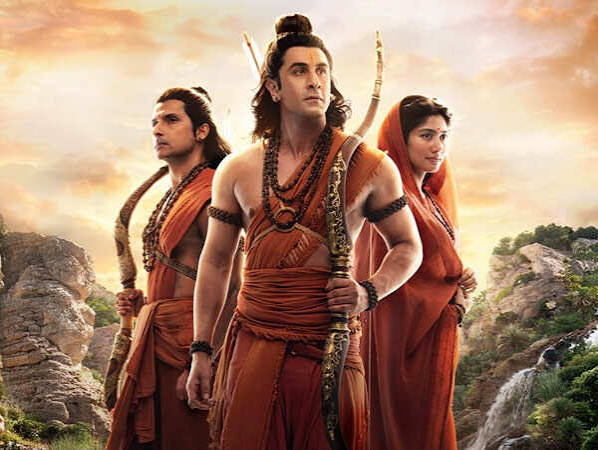
Ramayana Movies: The Ramayana has inspired filmmakers across languages, regions, and generations, beginning with Dadasaheb Phalke’s silent-era Lanka Dahan in 1917 and continuing through live-action mythological dramas, animated features, and modern visual-effects spectacles. Ranking these adaptations is difficult because every version reflects the technology, religious outlook, cultural context, and storytelling priorities of its time; nevertheless, some films stand out for their emotional depth, visual craft, performances, and faithful treatment of the epic.
At the top, Ramayana: The Legend of Prince Rama (1993), the Indo-Japanese anime, is widely regarded as a landmark for its striking animation, clear narrative structure, and accessible retelling of Rama’s journey. Classic films such as Sampoorna Ramayanam (1958), G. Aravindan’s Kanchana Sita (1977), and Bapu’s Sri Rama Rajyam (2011) are admired for their strong performances, devotional sincerity, and distinctive artistic approaches. Kanchana Sita, in particular, is notable for beginning after Sita’s exile and conveying her presence without showing her on screen.
Other important entries include Ram Rajya (1943), Seeta (1934), and Lav Kush (1997), which helped establish the epic’s long cinematic legacy. At the lower end, Adipurush (2023) attracted criticism for its visual effects, dialogue, character design, and creative departures from traditional versions of the story, despite its enormous scale and ambition.
This ranking celebrates the enduring power of Rama’s story while recognizing that every adaptation offers a new vision of an ancient epic.
Anime vs Live-Action
The 1993 anime Ramayana: The Legend of Prince Rama and live-action adaptations take very different routes to the same epic. The anime uses stylized, hand-drawn imagery to make the story feel timeless and accessible, while live-action versions rely on actors, sets, costumes, and CGI to create a more literal, spectacle-driven world.
Why the Anime Endures
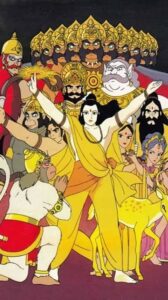
The anime remains influential because its animation style removes the pressure to make divine characters look “real,” allowing viewers to accept its mythic world on its own terms. Its remastered release has also been praised for preserving the epic’s teachings and emotional core, even though some action scenes now feel less fluid than modern audiences expect.
Where Live-Action Struggles
Live-action Ramayana films face a harder balance: they must honor a sacred and familiar story while delivering convincing spectacle. When the visual effects, dialogue, or character design feel unconvincing, audiences may feel that the spectacle overwhelms the spiritual and emotional heart of the epic.
In short, the anime succeeds through imagination, clarity, and stylization, whereas live-action succeeds—or fails—through realism, performance, and spectacle.
Audience Reviews
Ramayana: Part One has received a broadly positive audience response, with viewers particularly praising its visual scale, performances, and emotional moments. However, reactions are not uniformly enthusiastic: some viewers feel the film’s long runtime and compressed adaptation leave too little space for character relationships and story context.sacnilk+2
Audience ratings have been strong across major platforms: Sacnilk users gave it 9.5/10 from 238 ratings, IMDb showed 8.7/10 from about 8,900 ratings, and Rotten Tomatoes’ audience score stood at 93% from more than 50 verified ratings. Critics have been more measured, with Sacnilk reporting 76/100 from 15 reviews and Rotten Tomatoes reporting 75% from 32 reviews.
Common praise centers on the film’s grand visual presentation, Yash’s performance as Ravana, and the immersive scale of the world. Recurring criticisms include uneven pacing across its 3-hour-15-minute runtime, rushed emotional arcs, and the feeling that some parts of the epic require more room to breathe.
Box Office Performance
The film opened strongly in India, collecting ₹64.85 crore net on Day 1 across all languages, including ₹47.50 crore from Hindi. This made it the highest pre-Diwali Hindi opening and the third-biggest Bollywood opening overall, according to The Week.
Its momentum continued through the first week: it earned ₹107.50 crore net in India on Day 5, crossed ₹934 crore worldwide by Day 7, and became Ranbir Kapoor’s highest-grossing film. By Day 8, early estimates placed its India net collection at ₹53.50 crore for that day, while reports said the film had crossed ₹1,000 crore worldwide.
What It Means
The box office suggests that Ramayana: Part One benefited from enormous anticipation and positive word of mouth, even though critical and audience reactions were mixed. Its commercial success indicates that audiences responded strongly to its scale and spectacle, while its reception also shows that viewers remain highly attentive to how faithfully and effectively the epic is adapted.
Ramayana: Part One proves that India’s most enduring epic can still command massive attention on the modern big screen. Its grand visuals, strong central performances, and emotionally charged ending have connected with many viewers, while its commercial run demonstrates the extraordinary cultural and commercial power of the Ramayana story.
Audience response has been largely positive, particularly toward the film’s scale, Ranbir Kapoor’s portrayal of Rama, Sai Pallavi’s Sita, and Yash’s imposing Ravana. At the same time, some viewers and critics have raised concerns about pacing, the compression of a vast epic into one film, and the balance between spectacle and storytelling.
The film’s box-office success—crossing ₹1,000 crore worldwide within its first week—shows that mixed reviews did not prevent audiences from turning out in huge numbers. Ultimately, Ramayana: Part One is not simply another mythological blockbuster; it is a major new attempt to bring an ancient story into contemporary cinema. Whether it becomes a defining adaptation will depend on how successfully its sequel resolves the emotional, narrative, and spiritual questions raised in this first chapter.
Leave a Reply