
Over the last decade, Indian mainstream news has been undergoing a noticeable decline in influence, trust, and audience engagement. While once considered the primary source of news and information, traditional print and television outlets now face intense competition, credibility crises, and external pressures that have eroded their standing. Several interconnected factors—ranging from the rise of digital media to political and corporate influences—are driving this transformation.
Impact of Digital Media on Traditional Outlets
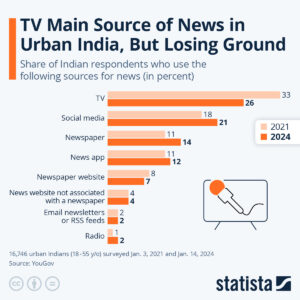
The explosion of digital media platforms has radically transformed how Indians consume news.
- Speed and Accessibility: Social media, independent digital outlets, and news apps deliver real-time updates faster than television or print.
- Diverse Perspectives: Online platforms give voice to citizen journalists, niche creators, and alternative viewpoints that were often absent in mainstream newsrooms.
- Younger Audiences Moving Online: Millennials and Gen Z prefer short-form, mobile-first news on Instagram, YouTube, and Twitter (now X), bypassing conventional broadcasts altogether.
- Economic Shift: Advertisers have moved large portions of their budgets to digital platforms, leaving traditional outlets struggling to maintain revenue.
This migration has created an ecosystem where the “first draft of history” is now written on social media, forcing mainstream media to chase trends rather than lead conversations.

Issues of Credibility and Trust
One of the most damaging problems for Indian mainstream media is the growing perception that it cannot be fully trusted.
- Sensationalism Over Substance: The pressure for ratings often pushes channels to focus on outrage-driven debates, celebrity scandals, and polarising topics, sidelining investigative journalism.
- Bias and Partiality: Viewers increasingly accuse certain outlets of favouring political or corporate interests, leading to a loss of credibility.
- Fake News and Poor Verification: In the race to be first, fact-checking sometimes takes a backseat, resulting in misinformation.
- Public Backlash: Independent fact-checkers and online watchdogs frequently expose biased or inaccurate reporting, further eroding public confidence.
Trust, once lost, is hard to rebuild—and for many mainstream outlets, audiences now cross-check information with multiple sources before believing it.
Political and Economic Pressures
Indian media operates in a complex environment where political influence and economic survival are closely intertwined.
- Government Influence: Political parties, regardless of ideology, have been accused of using advertising budgets, regulatory pressure, or direct ownership links to influence coverage.
- Corporate Ownership: Many large media houses are part of bigger conglomerates, making it harder to report critically on industries or partners that also fund them.
- Self-Censorship: Journalists sometimes avoid sensitive stories—be it about powerful politicians, big corporations, or contentious social issues—to safeguard their jobs and the outlet’s survival.
- Retaliation Against Dissent: Legal notices, defamation suits, or even threats have been used to discourage investigative reporting, creating a chilling effect in newsrooms.
Such pressures blur the line between editorial independence and corporate or political agendas, leaving audiences sceptical of what they see.
The Road Ahead
The fall of Indian mainstream media is not inevitable, but revival requires deep introspection and reform.
- Investing in Investigative Journalism: Outlets must prioritise fact-based, in-depth reporting over sensationalism.
- Transparency in Funding and Ownership: Clear disclosure can help rebuild trust.
- Leveraging Digital Responsibly: Mainstream media can use social media and digital tools not just for clicks, but for meaningful engagement.
- Strengthening Editorial Independence: Separation between business interests and editorial decision-making is critical.
Ultimately, audiences are looking for authenticity, accountability, and courage—qualities that, if restored, could revive the credibility and relevance of Indian mainstream media.
Is YouTube the best source for news in India?
According to recent scenarios, Young audiences in India are switching to YouTube for unbiased news and information that is not mentioned in the Indian Mainstream news. Already, many YouTube channels discuss important topics such as Mochak Mangal and Abhi and Niru.
Some are news channels which are independent, like The News Point, Newslaundry and Sunday Sarthak. Sunday Sarthak was on every Sunday discussed every week news in an entertaining way, which is informative.
Conclusion
In the end, Indian mainstream news, which is now full desegragated and that’s why Indian mainstream media fall down in Press Freedom Index. For more much such articles, follow on Screenverse Chronicles.